Türkçe için
When we first went to the disaster coordination center at the Library of the Iskenderun Technical University, we saw the coordinators caught between the phone pinned between their ear and shoulder and the people in front of them trying to explain their problems. That was when we understood what was going wrong. But let me go back to the first day.
On Monday, February 6, our usual morning routine at home was shaken by the hazy disaster news spreading through our phones. I was not in shock. After the 1999 earthquakes, I had grown somewhat used to the idea that “we have to live with earthquakes”, and, more importantly, the destruction had not reached the people close to me or me. I was tense and, above all, observant. Arda’s school was already closed that Monday because of the snow that had been forecast but never came. After dropping him off with his nanny, I headed to work. Traffic was moving more calmly than usual. As after every earthquake, a cold silence hung over the workplace. Hands raised to say hello rose a little lower, and the news clouded the smiling eyes. Oddly, people tend to act more collectively at moments like this. Teams shared their silence at the same lunch table, staring at their phones while their meals went cold.
I tried to focus on work to clear my head, but the news on my phone, the WhatsApp groups set up that morning, and the disaster-related posts had already wrecked my concentration. Amid the uncertainty, I contacted people in our search-and-rescue community to get accurate information. Friends who had built their careers in this field were already heading to the region, and what they told me was not good. The team, who had not seen each other in years, spontaneously decided to go to the disaster area to conduct search and rescue. I had just enough time to pack my bag before my friends arrived in Istanbul from Antalya. Schools for Arda and all the older children had also been suspended indefinitely.
On the road to İskenderun, I followed the aid efforts in the WhatsApp groups and tracked the locations of our team’s different vehicles and the status of those who had arrived. Although I was just one person going to search and rescue, with the phone in my hand, I felt like ten (!). I should have slept, but I couldn’t. My hand kept going to the phone, and I kept getting lost in page after page.
The phone’s hold on me loosened once we started working. In the field, it was a tool we used because we had work to do, not something we picked up to fill idle time. Some friends, for example, looked at maps of the area as it had been before the collapse to plan rescues. That luxury lasted two days. By the third day after the disaster, we could no longer find the old maps of İskenderun. It upset us a little, but we had to keep working.
Since it was my first time in a disaster zone, it was also my first time seeing a coordination center, and I was curious. We entered a modern building with high beams but low doors. A long, irregular crescent-shaped queue for food stretched out in front of us. To the right of the crescent, scattered groups waited to reach the AFAD officials. Announcements like “Only two people from each team should wait at the coordination desk, not the whole team” meant nothing to those in line. It wasn’t only the coordinators who were in shock. Everyone was.
At the coordination desks, communication moved around a triangle: the phone wedged between ear and shoulder, a trembling hand hovering over an empty sheet of paper, and the teams across the table trying to explain what they needed. None of the five desks, lined up side by side like a wall, had a computer. Everything was run by phone. One of my teammates put his finger on one of the main causes of the problems we would face with coordination over the next four days: “Ooh, it must feel so nice working by phone. Every call you finish, you think you’ve got something done, and you get a tiny little reward.”
On that first night, to avoid sitting idle and to sync up as a team, two of our members joined the coordination queue to request a night assignment while the rest of us went to the food line. When my turn came, the soup pot was empty, yet the crescent was just as long. Someone came in hugging a large box, said it was full of soup, and called out, “Come on, volunteers, let’s bring in the hot soup.” The people sitting in the middle of the room looked at each other and said, “We’re not volunteers, we’re operators.” Realizing where we were, in a coordination center in a disaster zone, we headed to our vehicles for the assignment.
The police escorted us as far as a street away from our work site, then left without waiting for us. Of course, there is a lot to be done in a disaster, but shouldn’t having law enforcement beside us at the rubble be part of coordination? We were the sixth team sent to respond to a report of a sound under the rubble. That was the result of a coordination run over the phone, with no record-keeping.
The disaster victims had phones in their hands too. Like us, they wanted to save lives under the rubble. The only difference was that they were trying to save their own loved ones. Every time they heard a sound from the rubble they stood over, their hands went to the phone. And what could the coordinators on the other end do? Which building was in what condition, where was which street, what was near what? There were no records. A map of the area was finally posted in the AKUT coordination center at the end of the third day. In return for this kindness, AKUT was removed from its spot across from the coordination center on the fourth day.
We woke up in our cars and were sent to another area for the second day’s mission, where the phone was effective again. This time the balance of coordination was upset not by repeated calls but by the weight of those calling. The Eda Apartment building, which had been grand and out of reach until it collapsed, drew every search-and-rescue team to it once it fell. When you compared the number of teams sent to the building with the number of people pulled out alive, it was clear the balance had been lost.


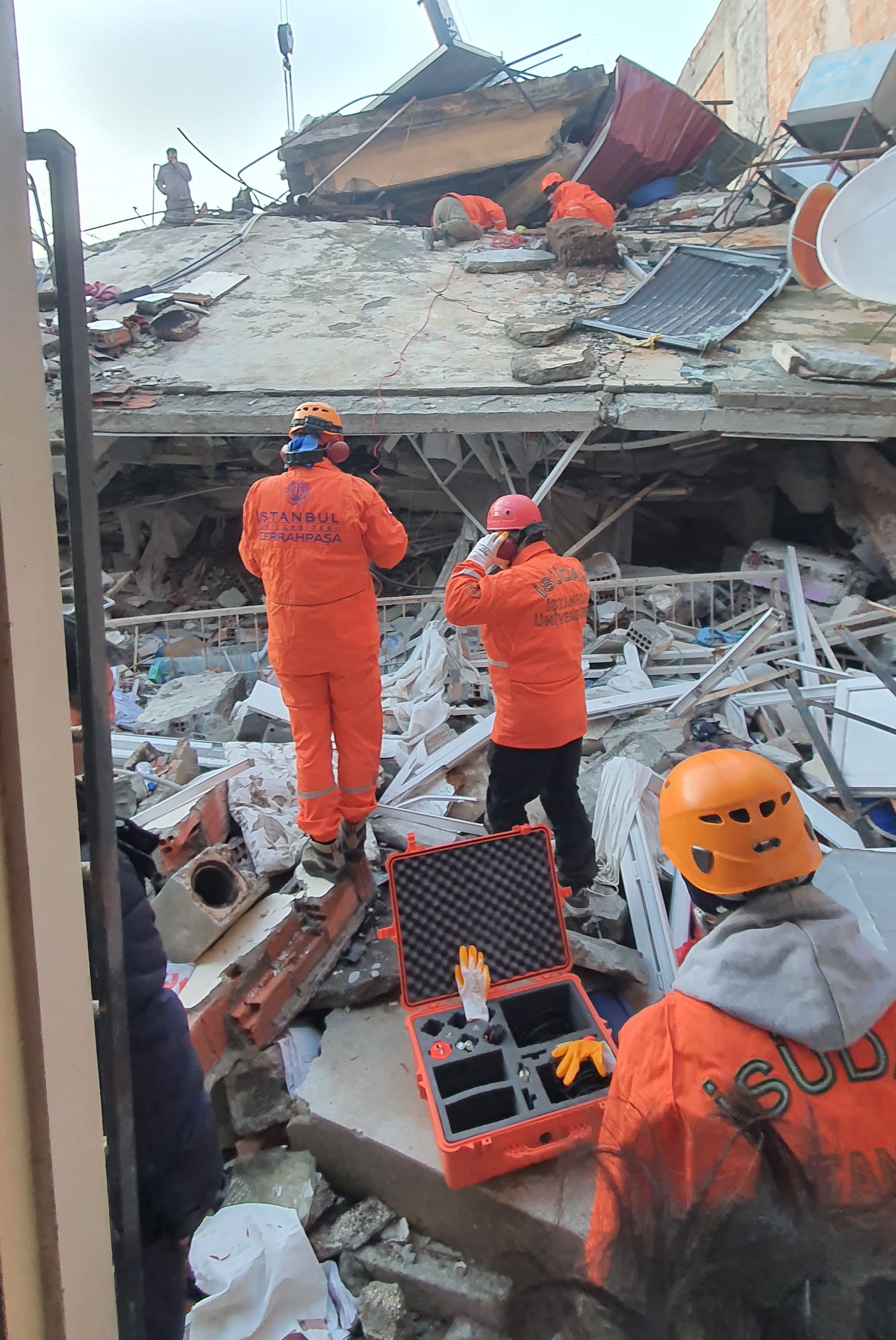
The second task of the second day was determined by the coordination center by combining a report of a sound under the rubble with the chance that our seismic listening device could pick it up. Teams sent earlier had reported that no search-and-rescue work was possible there, but the officer at the center seemed to assume the device could detect the sound remotely by pressing buttons and touching a screen. I wish it were that easy. I wish technology were as advanced as our dreams. I wish buildings had been built to withstand earthquakes.
We found the third task of the second day not through the coordination center’s direction but through the connections of the more experienced members of our team. Together with İsdemir, we worked alongside the Police Department for two days. Our contact with the coordination center faded. We were happy to be working toward our goal of pulling people out alive and to be giving the people of the region at least some support. While working, I had little use for the phone. On the day we pulled Fethiye Teyze alive from the rubble, I was the cameraman. I was the fourth person close to her. My job was to film the operation and, together with the team behind me, ensure the area was secure enough for everyone.

On our fourth day in the area, the fifth day after the disaster, we decided to leave. After that, my relationship with the phone went back to normal.
Leave a Reply